
Follicular Waves
What are they, when do they happen, how do they impact a menstrual cycle?

After my first son was born I breastfed exclusively for the first ~8 months, and then started adding in formula. I ovulated for the first time 11 months after he was born, with a period coming 4 days later. Before that, I had had three patches of egg-white cervical mucus, each about two weeks apart.
In working with people on period recovery, between that time and writing No Period. Now What? (NPNW) I noticed that other people were having similar experiences, looked in the medical literature and found the idea of “follicular waves” and so included some discussion around this concept in the book.
I want to share more of what I’ve learned since, as well as some really great illustrations that help explain what’s going on. In the next couple of posts I’ll talk more about what this means for what’s happening during the luteal phase, and then about how it manifests during recovery. So much neat research that I’m excited to share!
What are Follicles?
Let’s start at the beginning. A follicle is a structure, a fluid-filled sac, that grows in an ovary, around an immature egg (an oocyte, pronounced oh-oh-site). At the time of puberty, there are about 500,000 “primordial” follicles: a single egg surrounded by a layer of granulosa cells.
In the figure below, I point out a primordial follicle. The egg is the light pink and white circle with dark stuff in the middle (the DNA inside the egg!), surrounded by a thin layer of granulosa cells (quite stretched out, dark purple).
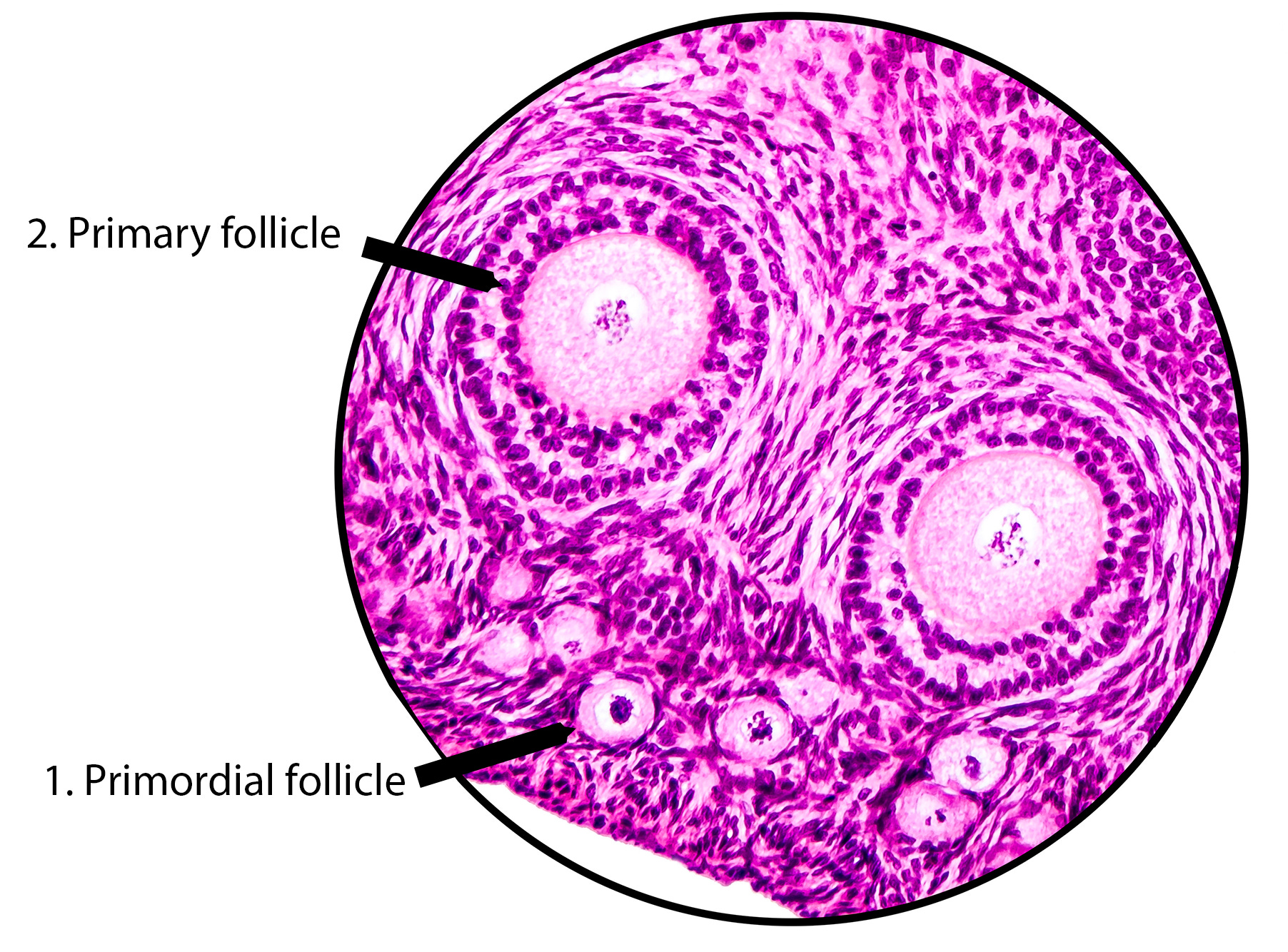
It takes about 150 days for a primordial follicle (0.03-0.06 millimeters in diameter) to develop to a primary follicle (0.06-0.12 mm). During that transition, the granulosa cells change in shape and function. They go from flatter to taller and more closely packed- “cuboidal.” They start making receptors that bind to FSH and also start producing estradiol. You can see in the illustration how much bigger the primary follicle is, as well as the changes in the surrounding cells.
Then another 120 days or so to become a secondary follicle, with another outer layer of cells called thecal (pronounced "thee" like theater-"cal") cells (0.12-0.4mm).
Twenty or so days after that, the tertiary (third) growth process begins: a fluid-filled sac forms, the follicle establishes its own blood supply, and continues to grow in size from 0.4mm to 2mm. At this stage they are called “antral” follicles and can be visualized using an ultrasound machine.
From there, the final selection and maturation process begins, driven by FSH. This takes about 10 days for selection (2mm - ~10mm) and 10 days for final maturation to a “Graafian” cell, through ovulation (10mm - 20+mm).
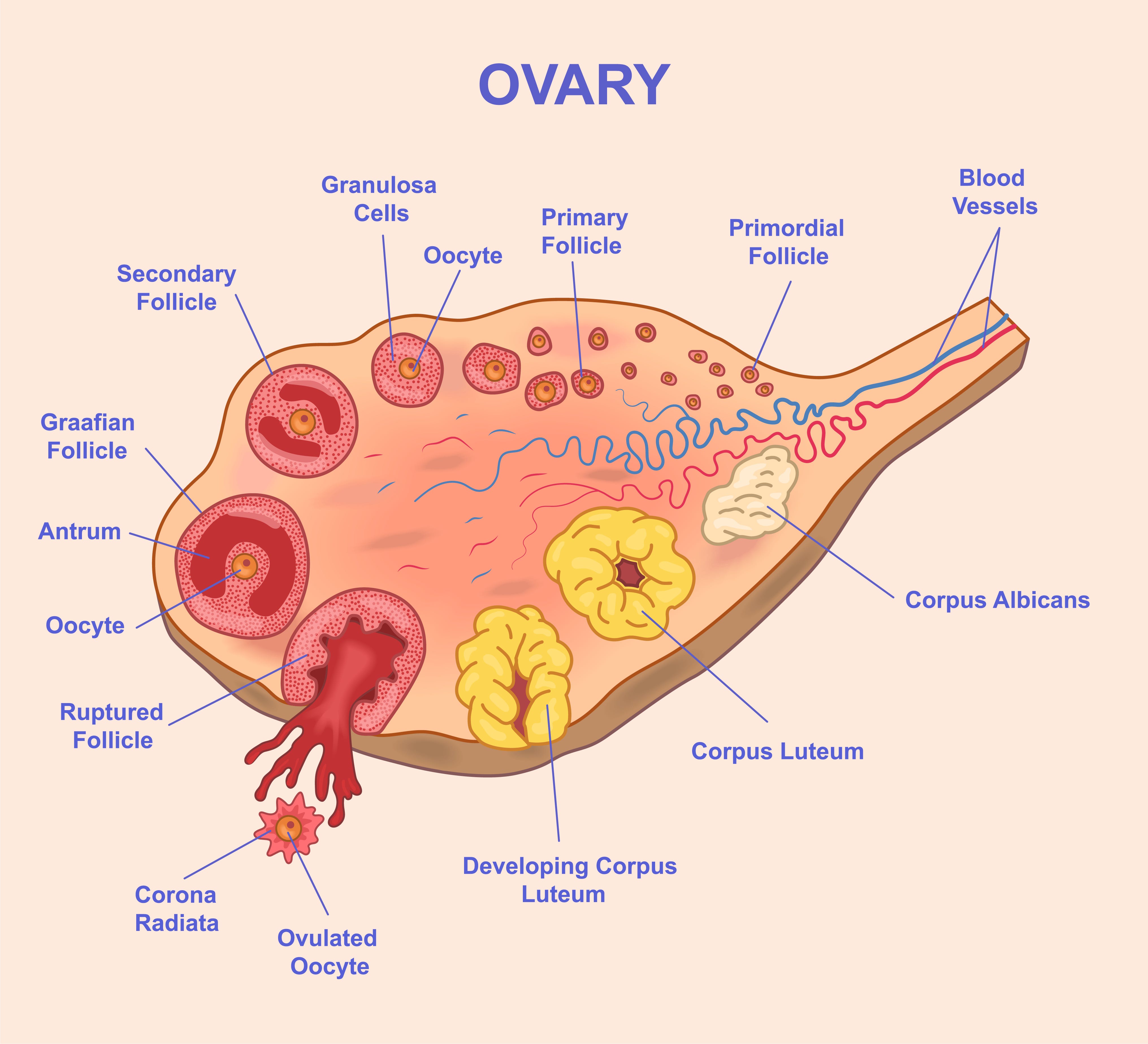
After ovulation, the granulosa and theca cells change to start producing progesterone to maintain the uterine lining - this structure is called a corpus luteum, and this can also be seen on ultrasound when one looks carefully - it’s a more filled in structure so can be easy to miss.
OK, the stage is set!
Follicular Growth Research Study
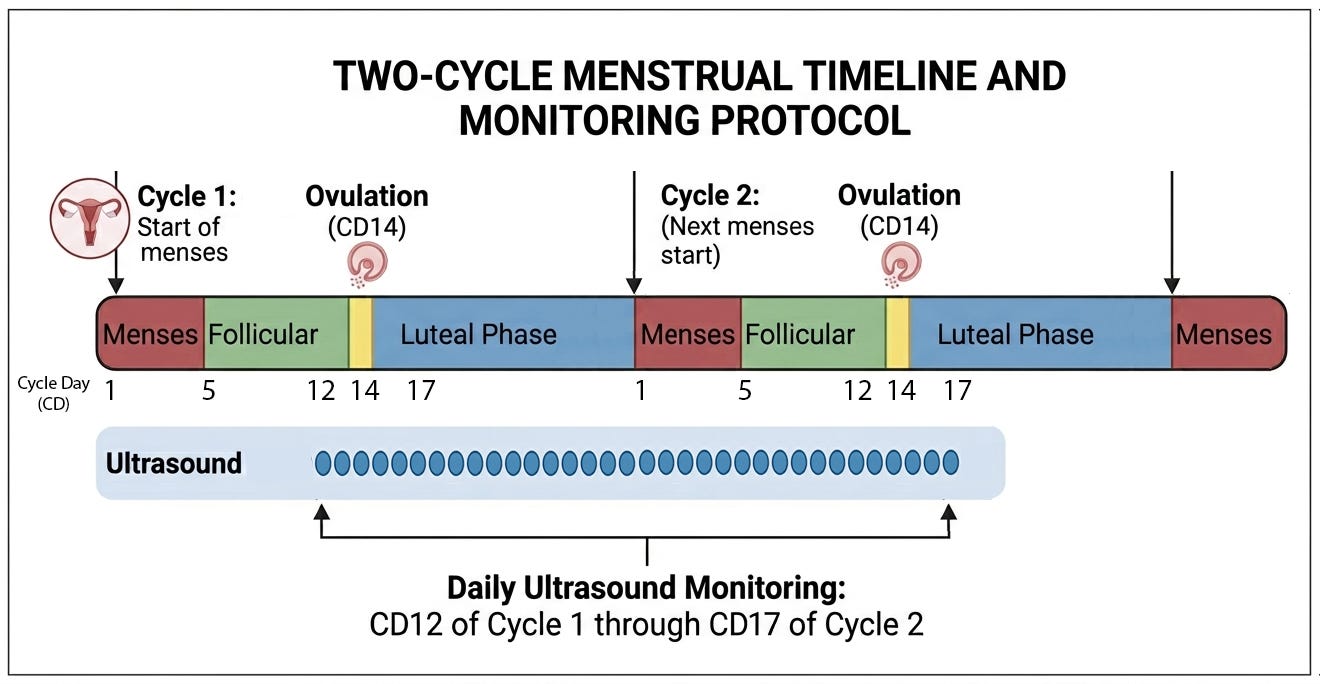
Baerwald, Adams and Pierson completed a phenomenal study, performing daily transvaginal ultrasounds in 63 women with regular menstrual cycles (see the illustration below). Monitoring started a few days before ovulation in one cycle, then continued until three days past the next ovulation. As a reminder, the first day of blood in a menstrual cycle is called “Cycle Day 1” and abbreviated CD1.
I want to note that is 34 consecutive days of transvaginal ultrasounds—the dedication of these 63 participants is why we have this data!
The researchers tracked follicles with a mean diameter of 2mm or more, and counted all follicles with a mean diameter of 5mm or more. They measured each ovary from four different directions, so that they could capture all the follicles as they grew.
Data from 13 women was not used: 1 with an overly long cycle, 4 with short luteal phase, 1 with a dermoid cyst, 7 with anovulatory cycles. Data from 50 women with “normal” cycles were collated and analyzed. I’ll talk a little more about the discarded data in another post.
TWO Follicular Waves?
The expectation was that there wouldn’t be much going on in the ovaries during the luteal phase (the time between ovulation and the menstrual bleed), and then there would be a crop of follicles growing starting with the degradation of the corpus luteum and the period.
The actual findings were quite different! It gets a little complicated, so I’ll walk you through step by step.
The first major observation was that in fact, there were follicles that were growing during the luteal phase. When you think about this, it makes sense. When the largest follicle is ready to ovulate, estradiol levels reach a threshold that leads to a release of a large amount of Luteinizing Hormone (LH) from the pituitary. This is what is measured on an ovulation predictor stick (OPK). When the LH is released, there is also a sharp increase in FSH… which goes to the ovaries and starts another group of follicles growing. It’s fascinating that the "failed" wave is actually the very thing that sets the stage for the next attempt.
The figure below breaks down the results in two ways. In the left panel, the average number of follicles >= 5 mm that were counted during each wave.
The first wave, which starts right around the time of ovulation, seems to have about 7-8 follicles that grow. The second wave starts… I would say right around the same time as the period. This gets up to about 11 follicles growing at once.
In the right panel you can see the size of the biggest follicle. In the first wave (again, this one starts around the time of ovulation), the largest follicle only gets to about 9mm. In the second wave, however, the largest follicle gets up to 20mm. Ovulation was confirmed by the disappearance of the largest follicle and a few days later the appearance of a corpus luteum.
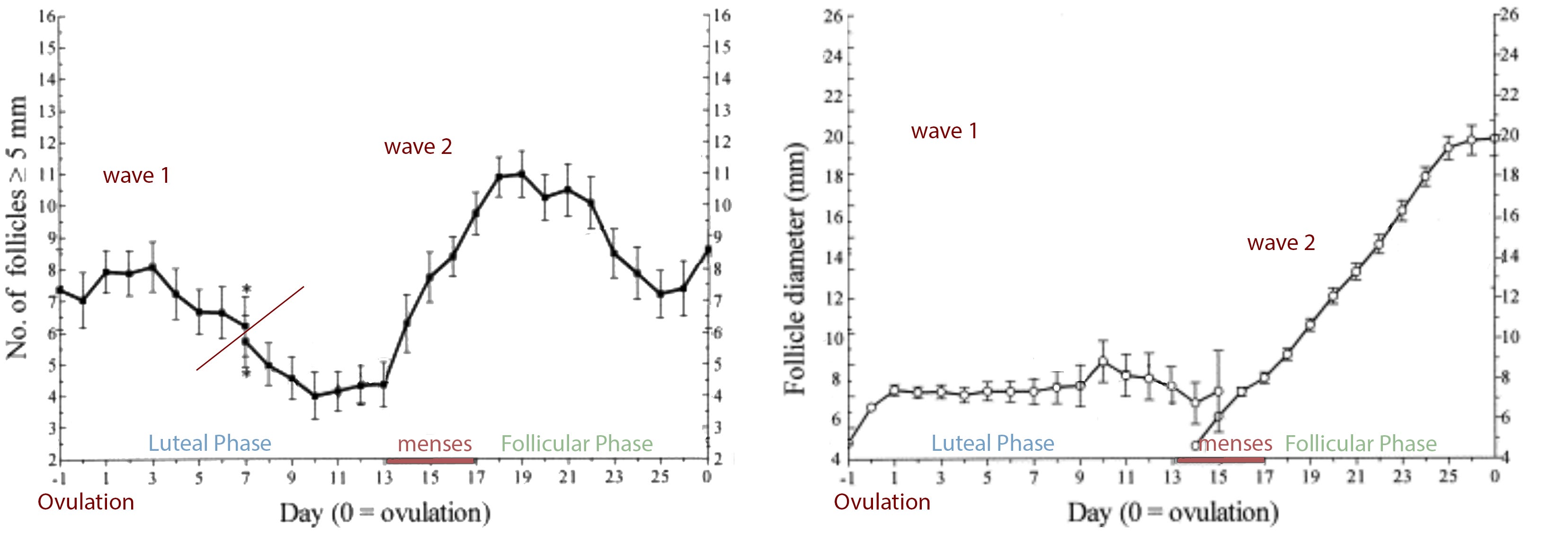
The researchers speculate that the follicles in the first wave (starting with ovulation) don’t grow to dominance because of the progesterone that is being produced by the existing corpus luteum. They also speculate that ovulation could be induced by giving LH or an equivalent, and this might be useful for fertility treatments.
What I think is really interesting is that the estradiol produced by these mini-follicles during the luteal phase would decrease as the follicular wave regresses (ends, decreases)… and that then leads to an increase in FSH to start the next follicular growth process. This clarifies the discrepancy between menses and ovulation that can occur with a short luteal phase.
In a subsequent study Baerwald et al. look at bloodwork, I will share that info in the my next post.
Out of the 50 women scanned, 34 (68%) followed this two-wave pattern.
I do want to point out that the error bars (the lines that go out from each data point up and down, indicating the range in number of follicles and sizes) are quite a bit smaller than I would have anticipated, indicating very little variability between people. I find that a bit surprising, but I don’t think it changes the observation of multiple waves of follicular growth.
THREE WAVES?!?!?!
Even more surprising, 16 women (32%) had THREE follicular waves!!!
I was able to separate the number of follicles from the maximum size of the dominant follicle when there were two waves, but with three it was even more challenging so I left the graph as it was in the paper, with the number of follicles (filled circles) and sizes (open circles) in the same illustration.
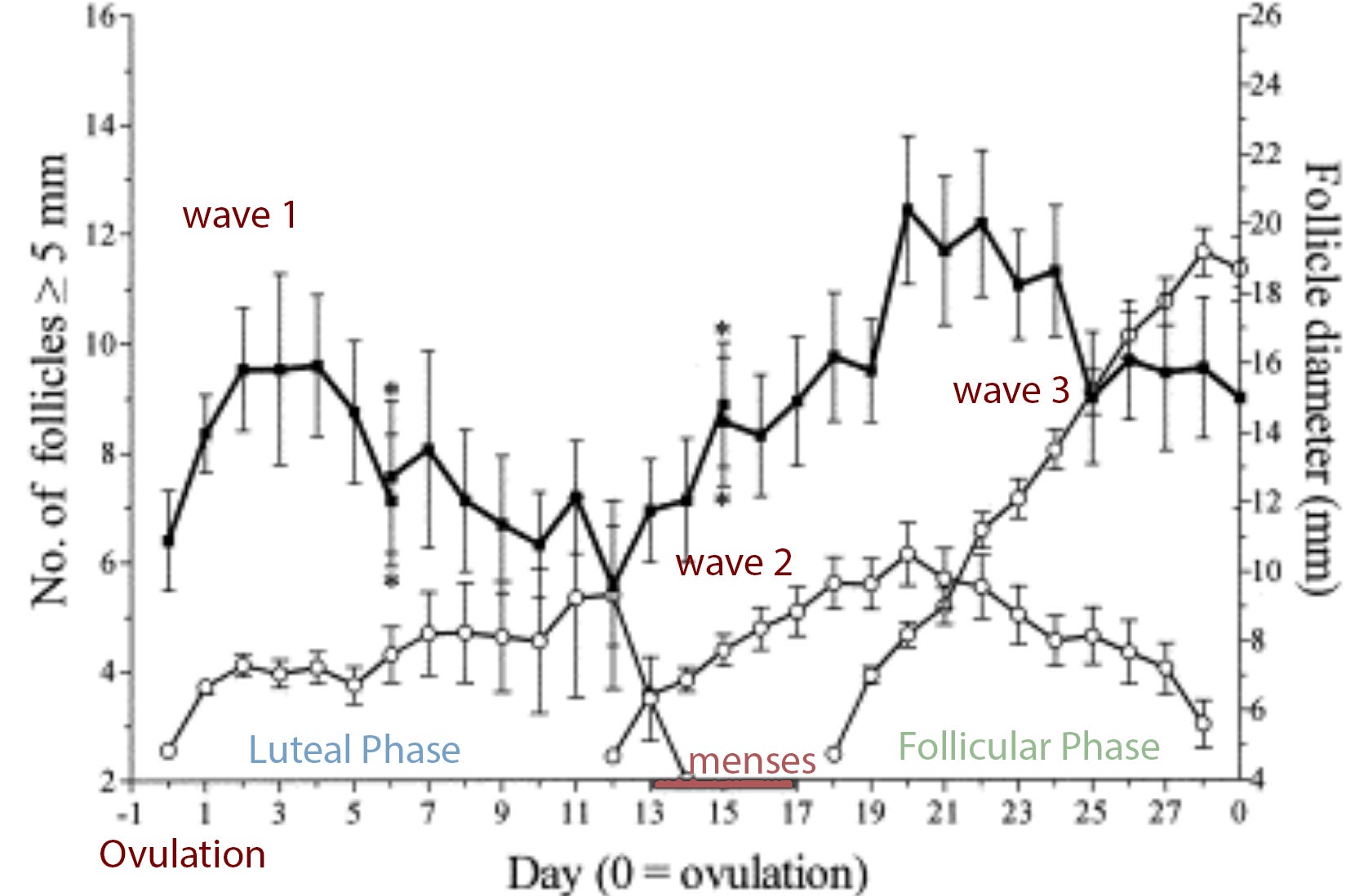
I find it harder to distinguish the waves by looking at the number of follicles >=5mm, much easier to look at the maximum size of the largest follicle. The researchers note this as well - they are able to distinguish on the ultrasound because the follicles are growing in different locations, but because of the overlapping waves you can’t see that as easily by follicle numbers.
For size of the largest follicle, it’s about 10mm for the first wave, starting with ovulation. About 11 mm for the second wave, starting around the same time as the period, and then 20mm for the third wave, where the dominant follicle starts growing the day after the period ends.
I think that these observations explain some surprising symptoms that people notice. For example, sometimes folks will notice egg-white cervical mucus during the luteal phase. This type of mucus is typically present close to ovulation… but also associated with higher estradiol levels. So, if estradiol levels are increasing during the luteal phase because of a follicular wave, that might be why.
More Observations
In someone with two waves, the average time between ovulations was 27.4 days, versus three waves at an average time between ovulations of 29.4 days.
About 1/3 of people with typical cycles had three waves.
In people with two waves, each was about 14 days long.
The first started on average 12 hours before ovulation (based on the FSH surge, which would have happened 24h before that).
The second started just over 14 days later, which would often correspond with the start of a period.
In people with three waves, the first was 12 days, the second 6-7 days, and the third on average 10 days.
The first started on average 7 hours before ovulation (again, based on the FSH surge associated with ovulation)
The second started 12 days later.
The third started 6 days after that, around cycle day 18.
The max size of follicles in the non-ovulatory waves was on average about 10mm, versus 21mm in ovulatory waves.
In larger follicles that did not end up ovulating, 4/66 (6%)grew to more than 15mm before regressing, and 20/66 (30%) grew to more than 10mm.
Takeaways…
When we have hypothalamic amenorrhea, our reproductive system is at baseline all the time. The suppressed hypothalamus means no FSH signaling, so no follicular growth. Once we start working on recovery, there can be a few attempts by our body to grow follicles, before getting all the way to ovulation.
This can be experienced as changes in cervical mucus, changes in other hormonal-related symptoms like acne, breast tenderness or heaviness, nipple sensitivity. I always tell people these are good signs, and to keep going with recovery work.
I find it really helpful to know that there can be follicles growing, that another batch will start growing when one doesn’t make it all the way to ovulation, and that this all is NORMAL.
The biggest takeaway here? Even when a period is missing, your ovaries may be “practicing” with these follicular waves, waiting for the right hormonal environment to allow one to reach dominance. Those patches of cervical mucus or temporary breast tenderness aren't fake-outs, they are biological progress. Did you notice these waves of symptoms during your own recovery journey / are you noticing them now? I’d love to hear about the signs you saw before your first true cycle returned.
Also, before we move on to talking more about the hormones, any follicular growth questions that this brings up for you?
This is SO interesting to me! I struggle with HA, but my amenorrhea can also be considered primary in nature. Reading the tidbit on primordial follicles around puberty was fascinating! It makes me wonder whether or not my series of unsuccessful follicular waves has anything to do with the fact that this is the first time my ovaries have EVER been "online"!